

Astronomy and stargazing
The right binoculars for astronomy and stargazing
If you want to explore the night sky, you don’t necessarily need a telescope. Even with a high-quality pair of binoculars, you can observe numerous celestial objects in impressive detail. Whether it’s the Moon, the Milky Way, planets in our solar system, constellations or the night sky during meteor showers such as the Orionids: a pair of binoculars offers fascinating insights into the world above us.
High-intensity optics for clear vision at night
When it comes to stargazing, high light transmission and good optical quality are particularly crucial. Models such as our ‘Sektor’ binoculars enable high-contrast observations even at twilight and in the dark. They are particularly well-suited to exploring the Moon, vast star fields and distinctive constellations in impressive detail.
Binoculars are the perfect first step into astronomy, as their wide field of view makes it particularly easy to find your bearings in the night sky and allows beginners to make impressive observations straight away. Vast star fields, the Milky Way and entire constellations often look particularly impressive through the wide field of view of a pair of binoculars.
Why binoculars are the ideal place to start
Binoculars allow you to see significantly more of the sky at a glance than a telescope. A typical 10×42 model offers a field of view of around 6 to 6.5 degrees – which is roughly twelve times the diameter of the full moon in the night sky. This enables you to locate constellations, bright nebulae or prominent star clusters intuitively and without a lengthy search.
Whilst a telescope provides greater magnification, at around 100x magnification it only covers 0.5 to 1 degree of the sky. This is ideal for details, but often too narrow for beginners, as it makes it difficult to get your bearings.
Anyone wishing specifically to observe the Moon and make out the first details of its surface would be very well advised to use 10x magnification. However, for even more detailed observation of lunar craters and other surface features, a spotting scope with higher magnification is recommended, such as the arena.
The easy way to make fascinating observations
Products for stargazing

adventure D 8 x 42

adventure D 10 x 42
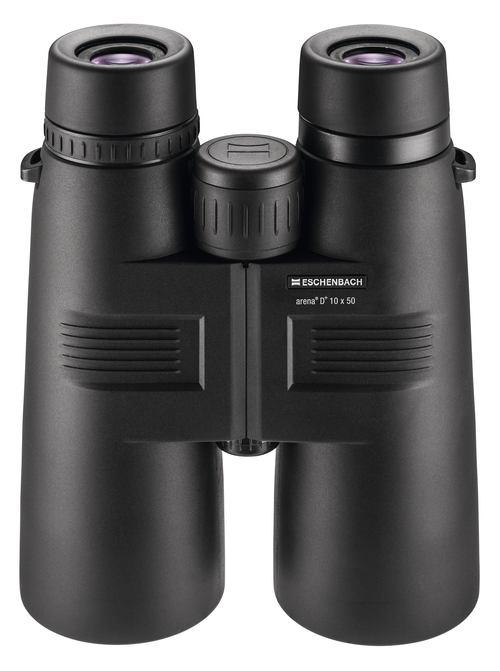
arena® D+ 10 x 50

arena® D+ 8 x 42
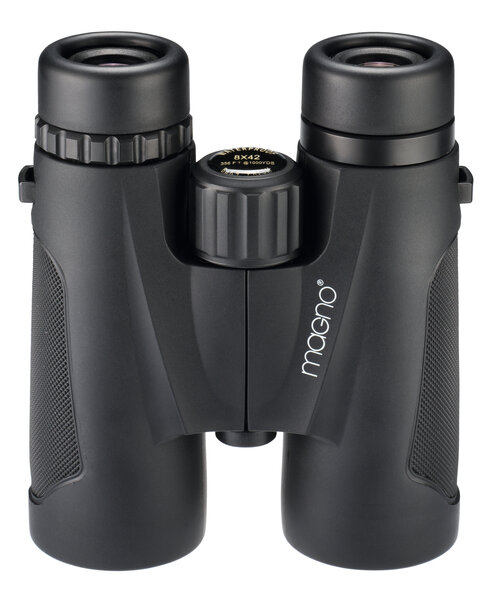
magno® D 8 x 42
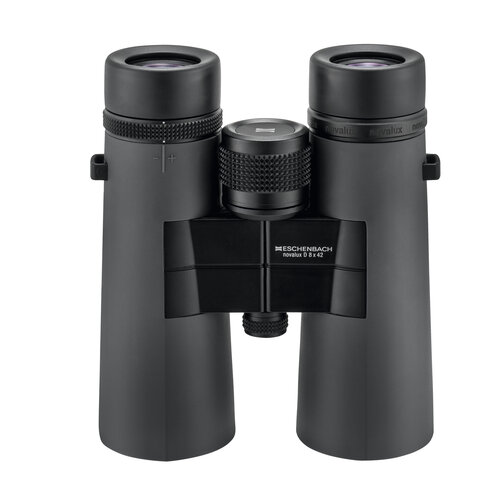
novalux® D 8 x 42

regatta® 8 x 42

sektor D 10 x 42 compact+

sektor D 8 x 42 compact+

sektor D 8 x 56 compact+

trophy® D 8 x 42 ED

trophy® D 8 x 56 ED

trophy® P 10 x 50

trophy® P 8 x 42

trophy® P 8 x 56

arena® S 20-60 x 60